The ADHD Food Freedom Course
A step-by-step course + workbook
for burnt-out neurodivergents ready to finally feed themselves without fighting their brain.
If you're reading this, I bet you're sure this is another thing that "won't work for you".
And still, you want a relationship with food that feels easy, aligned with your goals, and reliable.
You know exactly where you want to be.
But you can't seem to get there.
That's exactly what I built this for, friend.
Yes, I'm Over it!
You're in the right place if..
- You're perpetually exhausted, so food is the last thing you have energy to figure out.
- You keep waiting for a better moment to improve your eating habits, but it never really comes, making you feel stuck in your patterns.
- You feel disconnected from your brain and your body.
Food noise leads to binges, impulse control issues, and mindless snacking that makes you feel like food is in charge, not you. - You skip or miss meals all day, which messes with your energy, spikes your stress, and sets you up to eat past fullness every single night.
- You're overwhelmed with information and action plans that leave you frozen in your spot, wondering where to start.
- You're stuck on autopilot, and food feels like your only reliable tool to focus, to soothe complicated emotions, or to fill a gap in stimulation that nothing else fills.
- Perfectionism, diet culture rules, and hypercontrol keep backfiring into shame, guilt, and feeling like a failure.
- No plan, app, or approach you've tried seems to stick, so you keep landing back at square one, and your eating goals stay further out of reach.
Hits too close to home? I used to check every single one.
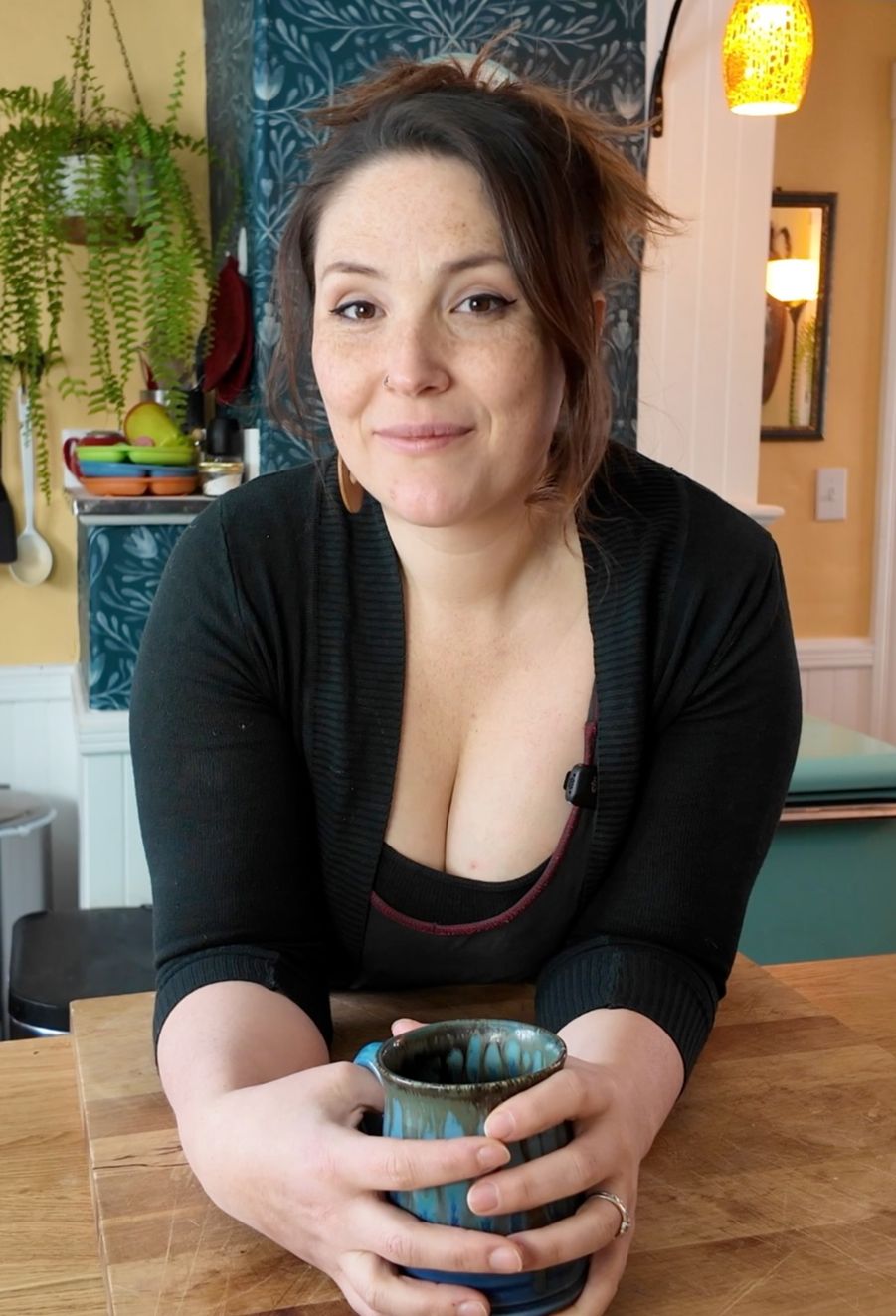
Hi! I'm Natalie Fox.
I spent most of my life undiagnosed for ADHD.
And I felt profoundly unsafe in my own body.
I started my first diet when I was 8 years old.
As I grew up, the food noise, the impulse control battles, the "perfect" eating that kept backfiring into binges, it all kept getting worse.
I went back to school for nutrition because I was passionate about it.
But even as I was training to become a dietitian, my own relationship with food was still far from the one I wanted.
I was in grad school, buying pints of ice cream, eating them in the parking lot, and going back inside for more.
The shame of being a nutrition professional who couldn't stop binging was its own kind of hell.
It wasn't until I stumbled into working with neurodivergent clients that I finally saw the pattern. In them first, and then in myself.
They were being set up to fail because the usual tools didn't work for them.
They didn't address the root issues.
They didn't account for their cycling energies, their sensory needs, their executive function, their actual lives.
So I started experimenting with kinder approaches. Listening to what was actually going on underneath.
Building tools around how their brains actually worked instead of forcing the standard playbook.
It worked. For them, and for me too.
So I pivoted my entire practice to focus solely on ADHD.
Now, with 6+ years of experience, a background in biochemistry, specialized training in eating disorders through Ample + Rooted, and 400+ clients,
I've found my way to the other side of my own food struggles, and I've built the framework I wish someone had handed me in that parking lot.
Here's what I see now that I couldn't see then
Everything you've tried has only focused on the food.
But your eating patterns aren't the problem, they're a symptom of needs that haven't been met.
Food became the only tool you have for stimulation, comfort, regulation, a break from the noise, etc.
When you try to take that tool away without addressing the need underneath, nothing sticks.
What needs to happen to see actual change is for these layers to work together:
- Physiological: hunger cues, energy crashes, sensory needs.
- Emotional: stress eating, boredom eating, food as reward or comfort, and the guilt-shame cycle.
- Neurological: focus, fatigue, impulse control, working memory, dopamine, task initiation, and habit loops.
- Practical: meal planning, grocery routines, time management, and kitchen setup.
When they're out of sync, you'll keep hitting the same walls.
And if this has been happening for a while, it can mess with your nutrition status, which can make your ADHD symptoms feel louder.
Executive function, mental flexibility, impulsivity, emotional regulation, all of it takes a hit when your brain isn't getting enough fuel.
It's not about what you've been "doing wrong".
It's about giving your brain the relief it's been asking for.
That's how feeding yourself finally becomes easy.
And every part of your life that has nothing to do with food gets easier too.
"Natalie is worth her weight in gold. She cares for her clients on a wholistic level; she not only has taught me about the science behind eating well but also helped me identify so many behavioral patterns as it relates to my relationship with food.
Her insight is incredible and she has helped me more in just a few weeks than anyone else has helped in 10+ years. 500000/5 stars!!"
Stacy
"I had struggled with my body image and issues around food for decades! Natalie helped me develop patterns to end my night time binging.
She helped me to challenge my all-or-nothing thinking, especially around moving my body. I am so grateful for Natalie's nurturing style and expert coaching!"
Susan
"The food freedom program was truly eye-opening. It explained why so many things I've tried before just didn't work (and it turns out it wasn't because I failed).
Now, instead of wondering why I can't live up to something, I ask myself what I can do. Natalie gave me a different definition of consistency so that I can make choices that make me feel good instead of worrying if it's "good enough.""
Tambra
"When I came across Natalie's Instagram it felt like she was a kind friend who could see inside my brain and could gently help me see food for what it is, a great and tasty way to fuel my body and a tool in my regulation toolbox. That is exactly what I got from my work with her.
She took out the complexity that I had created over decades of being told what food "should" be and helped me simplify everything so that I was eating in a way that gives me energy and supports me through the day while still ensuring I enjoy it! "
Julia
So how do you start working on all those layers while exhausted, stuck, and not even sure you can?
I designed this course to meet you at your most chaotic.
The messier you feel things are, the more this course has to work with, and the more you'll get out of it.
The goal is to build from the bottom up.
A floor that holds when life gets hard, and rises gently as you go.
Built in small, manageable moments that fit your life and your energy.
Here's How:
The Course gives you the why behind everything.
The Playbook tells you exactly what to do and when.
The Course takes you through the patterns and cycles, so you can finally understand your ADHD brain and what it's asking for.
Then the Playbook takes all that information and turns it into tiny, practical steps that actually slot into your day and start making a difference right away.
Both designed to avoid overwhelm and cut the guesswork.
Short, entertaining videos with visual-friendly text. Workbook activities built around curiosity and fun exploration.
All taking about 40 minutes per session.
You open it. You do it. You feel the shift in your eating habits.
What the journey looks like:
MODULE 1
Dopamine, Motivation & How to Set ADHD-Supportive Goals
What you'll learn: Why the goals you've been setting have been fighting your brain instead of working with it.
What will change: You'll craft goals to actually match your motivation and energy levels, so they're impossible to fail. No more setting yourself up to crash.
MODULE 2
Burnout & the ADHD-Supportive Environment
What you'll learn: How burnout actually works, what's really driving it, and why your eating collapses when you're burnt-out.
What will change: You'll redesign your environment so consistency no longer depends on having a good day. You'll learn to spot what's draining you (home tasks, work tasks, sensory noise) and restructure them so they stop siphoning your energy before you even get started.
MODULE 3
Regular Nourishment
What you'll learn: Your eating patterns decoded: binges, snacking, not eating enough, and how they impact your brain.
What will change: You'll build a nourishment system that works with your real life. A food list of your favorites. Low-spoon meals. Sensory snacks. A plan to keep yourself fed even when your brain won't cooperate.
MODULE 4
Emotional & Stimulatory Regulation
What you'll learn: Why food became your go-to for comfort, focus, and stimulation, and how to meet those needs with more intention.
What will change: You'll build a regulation toolkit with real alternatives to food. Short-term tools for when you're dysregulated right now. Long-term strategies for building regulation over time.
MODULE 5
Unpacking Perfectionism
What you'll learn: How perfectionist thought spirals have been sabotaging every attempt you've made.
What will change: You'll learn to catch perfectionism before it derails you. Build tools to challenge the beliefs that keep you stuck in "all or nothing." Replace rigid rules with something that actually survives real life.
MODULE 6
Unpacking Shame
What you'll learn: The damage done by rigid rules and diet culture messages, and why they hit ADHDers harder.
What will change: You'll build a toolbox to break the cycles of guilt and scarcity and start moving toward food-neutral, where food stops being a moral issue and starts being just food.
MODULE 7
Staying the Course
What you'll learn: A system built for the long haul. Flexibility, novelty, and a recentering plan for when things go sideways.
What will change: You'll build a floor high enough that falling off doesn't destroy what you've already built. A way back into your building that actually works when you need it.




What makes this different?
- You're not on your own. Every session has a comment section available. If you hit a wall, if you're not sure how to fit something into your life, you ask me there. I'll reply to you and we figure it out together.
- You can't fall behind. Go through a module per week or jump back after 6 months, you pick up where you left off. Your past progress is all written down, ready for you.
Every activity moves the needle. And every session starts with a refresher on what worked for you before. You see how far you've come, and it rewires your brain with proof of your success.
Everything is mapped out in one place. Course, workbook, resource sheets, toolbox, all organized so you always know where you are and what comes next.
Tools that stay with you forever. Can't figure out dinner? Open your food list. Can't start the thing? Task initiation page. Spiraling? Re-read your coping tools. It's all right there at your fingertips.
This is a living course. I'm always improving it. If something's missing that you need to succeed, tell me, I want to build it! And every update is yours automatically.
It gives your ADHD brain the structure it's been missing.
When feeding yourself gets easier —
- A craving hits, and you can stop and see what your brain is asking for.
- You feed yourself through your worst week ever, and it doesn't demolish everything you built. Getting back up takes less energy.
- You spot and scale down the things that used to drain you before you even got to food.
- Your focus starts holding a little longer. Your attention stops scattering in fifteen directions. The impulsivity starts to quiet down. Emotions don't spike as hard as they used to.
- One day you realize, the constant food noise has gotten softer. Your brain finally has extra room for the things you actually care about.
- The tools you learned in your food journey start showing up to support you in places you didn't expect.
- And slowly, you start knowing yourself in a way you never did before. You catch the crash before it lands. You talk better to yourself. You handle something hard and surprise yourself with how you got through it.
You feel what happens when your brain and your body are actually, consistently fed.


The goal of my 1:1 sessions is to teach my clients to coach themselves.
To understand their brains so well they don't need me in the room anymore.
That whole journey runs about $2,500.
And I'm not taking any more 1:1 clients until 2027.
But something as important as your eating habits shouldn't sit on a waitlist.
So I put everything into this course.
Same brain, same framework, same tools, same approach I use with every single one of my ADHD clients.
With the course as your map, the playbook as your compass and me in the comments as backup, so nothing gets in your way.
Everything you need to get unstuck,
yours for $395.
Start messy.
Start here.
Start feeling the shift after the first few minutes.
The Food Freedom Course + The Playbook
$237
Inner Circle Launch Offer: 40% Off!
Pay in 2, 3, or 4 interest-free payments, starting at $59
- 7 modules with 5+ hours of video lessons
- The Playbook: step-by-step workbook tracking your entire journey
-
My Toolbox: your food lists, sensory snacks, low-spoon meal guide, coping tools, task initiation toolkit, regulation strategies, and resource sheets all in one place
-
Integrated Q&A space: ask Natalie anytime you're stuck
-
One purchase, no subscription. Yours forever, including all future updates.